Showing posts with label Computers. Show all posts

Saturday, August 6, 2011

External and Internal Hardware Qualities of an Intel Motherboard


When looking for a motherboard of the computer is great to see what Intel has to offer. There are many things to see in Intel motherboards that work with getting computers to work properly. This includes its functionality with many devices and support for different processors.

The first Intel processors, which Intel motherboard can work with are numerous. Some motherboards use LGA 1156 socket option. It is a socket that can handle Core i5, i7 and Core Xeon quad-core processors in nearly three gigahertz. Some motherboards still use the LGA 775 format for other types of processors. It can still work with many Intel Core 2 processors, including Pentium D and Pentium 4 options.

number of memory devices can work on Intel motherboards. DDR2 and DDR3 memory, hardware devices can be used on the motherboard. Memory values ​​that can be added can be especially visoka.Matična records on 64-bit system can handle eight gigabytes of memory. Error Correction Code memory can work at home using some bits of data validation errors.

integrated graphics can be used on many Intel motherboards. This is the Graphics Media Accelerator, which is integrated into the motherboard. This may help to produce high-definition video and add support for Blu-ray discs. DVI outputs can also be used on the motherboard. With this the user will not have to spend extra money to get a new graphics card.

of different types of PCI slots can be used on motherboards with Intel too. This is useful in that the grooves can be used to help with expanding computer needs. Some motherboards can handle PCIe x16 slots that work with larger bandwidths. It helps to know that different products from Intel will work with different amounts of slots.

There are many different types of peripherals that Intel motherboard can do. It is thanks to the ability of these motherboards to work with different sučeljima.Tipično motherboard can operate up to twelve separate USB 2 0 ports. ESATA ports can be used. ESATA is an external form of SATA interface that works with faster data transfer rates.

When checking out the Intel motherboard, these factors should be those for vidjeti.Memorije and processor that can handle the expansion areas are great vidjeti.Sposobnost to work with all sorts of things from the outside is another thing to check.

AMD at Intel's Heels, Where Are We Heading?


Intel Corporation was founded in 1968 as Integrated Electronics Corporation, based in Santa Clara, California, USA. In 1991, Intel has achieved a number one ranking of the semiconductor market share, and they held fast to their positions today. Semiconductor technology advancing at a rate of relentless, fast throw-away society and technology tends to generation. In a market where innovation and invention play such vital roles, it is an outstanding achievement for Intel kept one step ahead, keeping the crown among the competitors.

But who is there to compete against the CPU giant? Last year, Intel boasted an impressive profit margin of 22.3%, leaving plenty of slack to reduce prices in the face of competition. With the recent integration of Intel's technology, Apple, who chose to adopt the Pentium CPUs for workstations, it seems Intel is based are set firmly in the uneasy ground semiconductor markets.

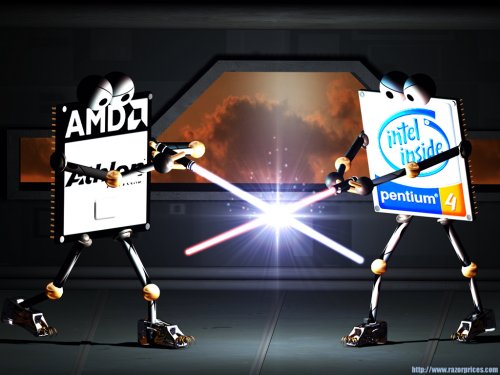
AMD, Advanced Micro Devices, a U.S. manufacturer of integrated circuits based in Sunnyvale, California. This is the second largest supplier of x86-compatible, or desktop workstations, mobile and small-scale server processors, Intel follows. AMD is 15 among the world's top twenty-semiconductor sales leaders, generating revenues of $ 3.9 billion in 2005.

AMD worked as a licensed second source manufacturer Intel processors, but in the face of the growing popularity of the PC clone market, in 1986 Intel decided to do without it considers its competitors to start production of a CPU on its own terms. This action led to a prolonged and bitter legal dispute in which he claimed AMD Intel has violated its ugovor.Vrhovni Court of California agreed, and forced Intel to pay over $ 1 billion in compensation.

In 1991, AMD released the Am386 processor, and then with the Am486 in 1993. Both are competitively priced, undercutting Intel equivalent. AMD quickly established a foothold in the semiconductor market, particularly in computers and workstations on the level, selling millions of units of the former in less than a year.

more than a decade, and AMD continues to increase its share to keep the semiconductor market, carried out its competitors with aggressive pricing and partnerships. Today, 24 July 2006, AMD has announced the acquisition of ATI, a major supplier of desktop graphics cards, a transaction valued at approximately U.S. $ 5.4 billion. As our process-centric to play more roles in our lives, it is not difficult to imagine a day when the PC is sitting alongside, or even integrated into any TV. With innovations such as Sky + customers on the idea of ​​opening the media center computer in their living rooms, and then their cars and mobile phones, its clear why AMD sees potential in the development of processors with integrated graphics functions and routines.

major semiconductor market is an exciting experience at both ends, but as consumers we have only benefited from increased competition and demand, and de-monopolisation of the semiconductor market. New products from either side of such competition increases innovation and lowers prices, which may be good news!

Thursday, August 4, 2011

The AMD and Intel MHz Controversy


I've been into computers since I was like 10 years, now 25 years old. Since then I've always thought that Intel has jacked your clock to make it seem faster than AMD's normal computer users. Until a few years ago that is still what I am, however, that Intel is trying to deceive anyone. I now know what the difference is that Intel does not lie on their clock speeds are merely different factors are higher.

This post is aimed at people who have the same beliefs and set the record straight. It is by no means meant to be in-depth article in the pipeline and how the CPU work, etc. This is just to give you a basic idea why there is a difference between AMD and Intel MHz MHz.

First MHz MHz no matter what, there is no difference in any MHz.MHz the unit of measure like inches, feet, etc. MHz, one million Hertz, MHz short for megahertz. MHz are used for measuring data on electronic devices. Basically 1 MHz means that the device can process information millions of times per second. Now lets move on to how AMD and Intel are different.

a computer program running on the computer and send the instructions for the CPU to provesti.Program send instructions such as 1,2,3,4,5, but the CPU can execute instructions, such as 3,4,1,2,5, to called "out of order." CPU breaks every instruction down into pieces, such as 1a, 1b, 1c, and so on, but the CPU can execute before 3a 1a and 2a, the last because it is waiting for data from 1c. It becomes very complicated and I could never explain how it all works. This is the only way to realize that the CPU is very complex and the execution of the program is very complex.

Basically this is where Intel and AMD differ. The difference in speed comes from how fast the processor can execute instructions out of order and how quickly the pieces can be made. Imagine that you need to build a brick garage and you have 22 or 31 small trucks to carry the bricks on the site. Then imagine the second place you have 12 large trucks to carry the bricks. What do you think will be done faster? If you choose 12 more trucks, and to your right is the path that he chose AMD. Intel has chosen the second time that turned out to be the wrong one (the information about the pipeline refers to the older Intel and AMD processors ).

What happens here is that the Intel CPU to complete a simple task that has to do 22 or 31 items and the AMD CPU has only until 12 What this means is you have AMD CPU runs at 3.0GHz and 4.0GHz Intel for the Intel chip for less work per clock cycle, and more cycles. Basically Intel chip runs faster in MHz, but for a lot more work for the same result.

This is why Intel and AMD MHz may not coincide, because there are many other factors that go into figuring stroke. Just because the Intel chip sports faster clock does not mean it is faster in real world applications of the slower clock speed AMD chip.

Being dumped Intel Net Burst model for its CPU now uses 14 stage pipeline, which is much better. The use of multiple pipelines and running at high clock rates is causing overheating and other problems for them anyway. These new Intel processors require less power and can operate at cooler temperatures. So here was one Intel, AMD is now only say they were right all along and I'll be happy. AMD is stuck with a 12 stage pipeline in its Phenom processors.

Again, this article is only to be put to rest some of the misunderstandings that AMD and Intel figured clock rates and why the slower clock CPU AMD can be done quickly sat Intel CPU. This is true for older AMD and Intel processors, AMD has lost the battle gear now that Intel has reduced the number of pipeline down. If you find any of my information is incorrect please leave a comment or shoot me email using my contact form.

Wednesday, August 3, 2011

10 Years Ago in Technology - Remembering Our Roots, a Techie's Retrospective


There's an old adage in the auto industry, which says a vehicle loses value as soon as you put him off puno.Računala and technology industry is not so different, in that new parts and systems are constantly pushing the boundaries of performance and value, it is impossible that the top-of-the-line system for very dugo.Svrha this work is to take a step back in time 10 years, and then examine the technology landscape to see how it compares with today's technology we know and love.

Moore's Law:

Much has been written, and much more is discussed about the technology called the axiom, Moore's Law. Some people interpret the law means a doubling of computer power every 18 months to 2 years, while others maintain that means doubling the number of transistors (the microscopic on / off switches, if you will), engineers were able to print the same amount of silicon. In fact, Moore said that transistor counts would double every year, which was later amended to every 2 years) despite this trend, and transistor performance growth has remained loyal for more than 40 years.

More recently, Moore's Law is applied to the graphics processing unit (GPU), as dobro.GPU is actually not even 10 years at the time of writing. The official term was coined by the GPU nVidia GeForce 256 series 3D cards. Released in August 1999, this was the first chip that is able to calculate the peak pixel transformation and lighting hardware. Since its release, the graphics processing power has followed a similar trend of doubling performance every 18 months to 2 years. This article is not a technical document, a review of the past 10 years to give you an idea of ​​how far we've come in such a short time.

A little history about the author:

in 1999. This was my student / junior year in high school. Now I'll pause so that 90% of readers who grew up in the 70s and 80s can turn your nose and stop reading.

Ok, now it's out of the way, let's continue.

I have internet child. I got into computers, and all manner of electronic geekery as the Internet has become something that "might just catch on." My high school was not quite on the bleeding edge of technology as they were, but we were one of the first public school in my area to be equipped with a full T1 line and a 1.5Mbps and an awesome dedicated bandwidth that lead through the network. Our network is built from the hodge-podge mix of nicely PC labs (mostly K6 200MHz/Win 95 machines), a nightmare network engineers fabrication Macintosh;. LC II is the new iMac G3

In 1999, I was still rocking 486 DX-33 computer with 8MB of RAM and Windows 3.11 as my computer at home, while my parents had a nice Pentium 100 Windows 95 machine, my brothers and sisters, I would fight for a while. So what is the point of these last few paragraphs are probably wondering? Well, that's where I was and what I was using 10 years ago in computing, and we hope that got you thinking back a decade on what is cloud computing.

processors

10 years ago today, the world of the computer itself is in a frenzy, getting ready for the near future release a brand new Intel Pentium III procesor.Najbolji their money could make the Pentium II processor at 450MHz with PC100 memory. Rival AMD was doing okay for himself peddling their budget conscious K6-2 series processors. Your average computer cost around $ 2000 - $ 2500 at this time to a computer with a Pentium II solid procesor.Pentium III should be published 26th February and was the subject of a vicious debate over the merits of its built in a unique ID number. Also noteworthy is its inclusion of the first SSE instruction set (modern Core i7 processor is the SSE4 +). However, no software is designed to make use of new instructions that the processor was much faster than had equal Pentium II processors and took very little heat from the press.

Graphics:

on the graphics front war between nVidia and 3DFX was furious. nVidia, relative newcomer to the field, riding high on top of their highly successful TNT (Twin-Texel) video processor, and 3Dfx fought to retain his title the market leader with its line of graphical kartica.Voodoo Voodoo3 cards are excellent performers, but TNT card had the advantage of 32 bit color, while the Voodoo's were stuck at 24 bits. ATI has been around and kicking with their rage series of 3D cards (especially popular as integrated chips in servers and workstations), but they never really got into hardcore 3D accelerators race to the Radeon line debuted in 2000.

Internet:

In 1999, the Internet boom is just starting and attracting massive amounts of attention and investment capital from all over svijeta.Veliki job at that time was in search and portal business. Yahoo, AltaVista, Excite, Lycos, and were perhaps the most distinctive and sizable players in this industry. Google-say-wha? Other companies in other industries, such as television and ISPs have been taking notice, and Internet portals to buy the right and left hand in an attempt to tap into the viral spread of the Internet. New technologies such as Java came into his own, and began laying the groundwork for the internet as we know it today. Studies showed that by 1999 about half of American households have a computer, and most new computer purchases have been made ​​to get online.

Other areas:

PDAs are fast becoming the new must have gadget.Palm Pilot device that led the charge. I had a Palm IIIe to half of 2000. Personal pagers are still hot sellers, but mobile phones are getting smaller and more practical and affordable. Also, the war was warming up in the area of ​​computer memory. Samsung unveiled a new DDR memory chips that promised to double the effective throughput of the existing memory chips in a future setting, but Rambus has been busy developing their own high-speed RAM for use in high-end Intel systems.

Software:

This field is perhaps a little too much to cover here, but briefly recap OS: PC World is running strong with Windows 98, and anxiously waiting for an updated Windows 98 Second Edition will be released in May 1999.Macintosh crowd is plugging away happily on Mac OS 8.5 machines, while waiting for an update OS 9 later that same year. Linux is also starting to come into its own, as well as the big name manufacturers such as IBM are beginning to bundle distribution of RedHat, Caldera, and others with some servers.

Conclusion:

I'll admit this article is more for my entertainment and remembering than anything else. I hope that sometime during this mass of words and broken sentences, and you have some good memories of the computer equipment of the past. It is good to remember the technology we grew up with, and we are fortunate enough to have a robust Internet are used today to describe pictures and technical specifications of those glory days. Tech sites like Time Machine are there to help us relive those days, and have a little laugh at the gear we thought we would never use to its full potential. I remember touching the machine Pentium 200MMX for the first time and in awe of his raw speed and seemingly endless possibilities. Now I am constantly arguing with my current speed of 3GHz dual-core Athlon X2 6000 + PC. I can not even imagine how many windows to Pentium 200 will be thrown out today. This is a crazy world we live in